Does Talking to Your Baby Actually Make Them Smarter? The Science Is More Interesting Than You Think.
"Talk to your baby" is advice that's everywhere. But what does the research actually show — and does any of it hold up under scrutiny?
"Talk to your baby more." It's in every parenting book. Your pediatrician says it at every well-child visit. There are government campaigns about it. If you've spent more than ten minutes in parenting spaces online, you've seen some version of the claim: babies who hear more words develop faster, test better, do better in school.
But here's what nobody usually explains: where that idea actually came from, how well it holds up, and — most practically — what kind of talking actually matters.
The 30 Million Word Gap: The Study That Started Everything
Almost every "talk to your baby" message traces back to a single landmark study. In 1995, researchers Betty Hart and Todd Risley published findings from a years-long observation of 42 American families across different socioeconomic backgrounds. Their headline conclusion: by age three, children from lower-income families had heard roughly 30 million fewer words than children from higher-income families — and that gap predicted language ability and academic performance years later.
This study was enormously influential. It launched national campaigns, shaped pediatric guidelines, and created an entire cottage industry of products and programs designed to help parents "close the word gap."
Then the critiques started.
Researchers pointed out the sample was tiny — 42 families — and not particularly representative. Later attempts to replicate the findings at scale got murkier results. The link between word counts and outcomes turned out to be hard to separate from everything else that correlates with socioeconomic status: nutrition, stress, housing stability, access to healthcare. Critics argued the "word gap" framing flattened a complex problem into something that put the burden on individual parents rather than structural conditions.
So does talking to babies matter or not?
It does. But the research since 2000 has gotten much more specific about what kind of talking actually moves the needle.
What Harvard's Brain Imaging Research Found
A 2018 study from Harvard, MIT, and the University of Pennsylvania did something the original word-count research couldn't: they put children in MRI scanners and looked at their brains directly.
What predicted stronger language development wasn't how many words a child heard. It was conversational turns — the back-and-forth exchanges between parent and child. Baby babbles, parent responds. Baby points at something, parent follows the gaze and names it. Parent makes a face, baby mirrors it back.
The children with more of these exchanges showed measurably greater activation in Broca's area — the part of the brain central to language processing. The quantity of words in the environment mattered less than whether those words were part of a real interaction.
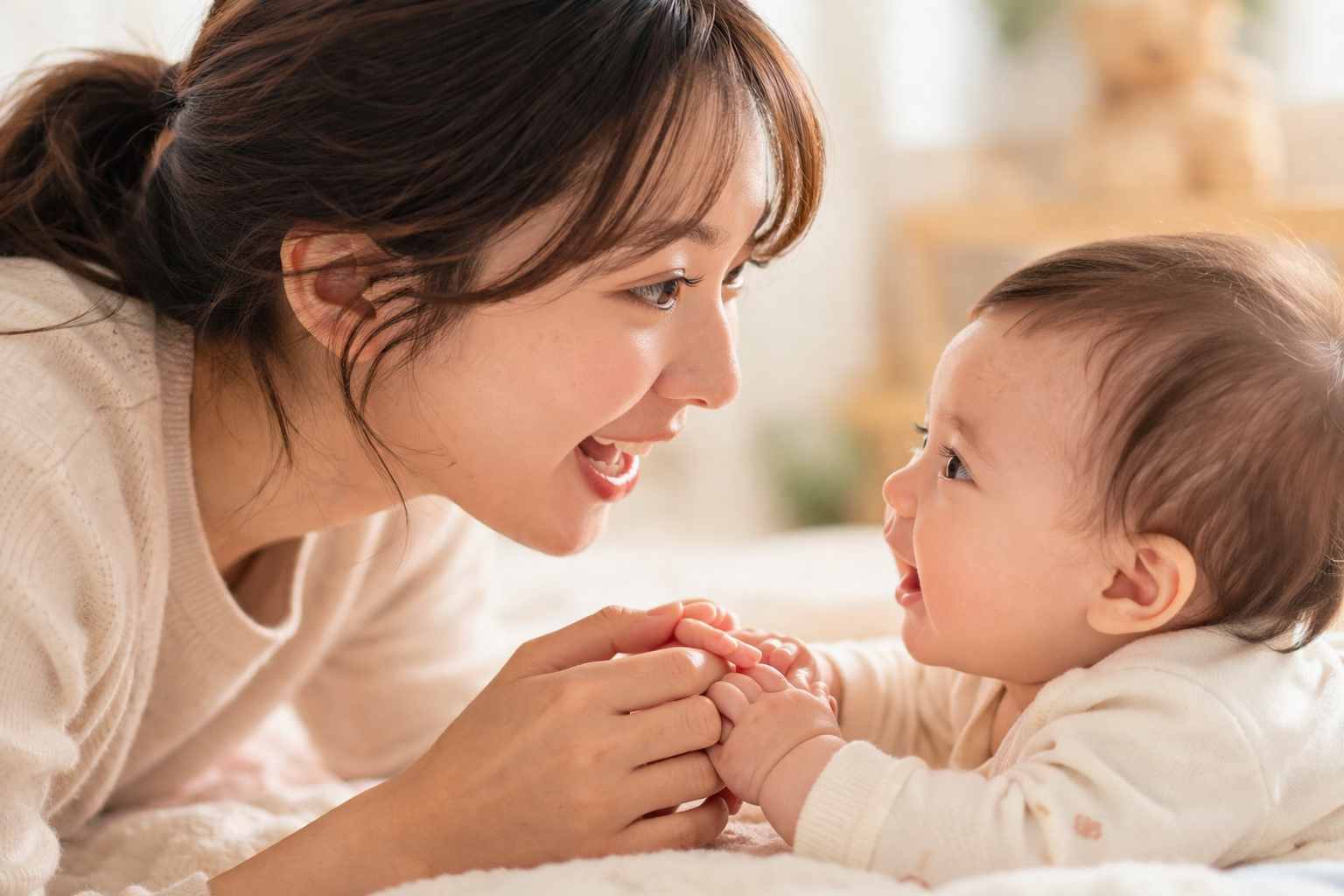
This maps onto what Harvard's Center on the Developing Child calls "serve and return" — one of the most well-supported frameworks in early childhood development. Think of it like a tennis rally. The parent serves (a word, a look, a touch), the baby returns (a sound, a movement, a gaze), the parent responds to the return. Each exchange builds neural connections. Interruptions in that rally — from distraction, stress, or simple unavailability — are what researchers flag as a concern, not the total word count.
The Screen Question
If conversational turns are what matter, the implication for screen time becomes pretty clear.
Researcher Patricia Kuhl ran a memorable experiment: she exposed American infants to Mandarin Chinese either through live social interaction or through video of the exact same content. The infants who learned from a real person showed measurable language learning. The video group showed almost nothing.
Kuhl's explanation: the brain has a dedicated circuit for social language acquisition that seems to activate specifically in the presence of a real human interaction. Screens deliver the phonemes but not the social context, and the brain — at least in infancy — doesn't process them the same way.
This is worth sitting with if you've been running educational YouTube videos hoping for a language boost. A parent narrating what they're doing in broken, imperfect sentences, while making eye contact, probably does more than hours of a native speaker on a screen.
What This Actually Looks Like in Practice
The research points toward a few things that are practical without being overwhelming:
Narrate your actions. "We're changing your diaper now. Cold wipe, sorry about that. There, all done." You don't need clever content. Describing what's happening in real time counts.
Follow the baby's attention. If they're staring at the ceiling fan, talk about the ceiling fan. Language acquisition research consistently shows that words land better when they're connected to whatever the child is already focused on — not whatever you've decided is educational.
Let silences happen. "Serve and return" requires the baby to have time to return. Parents who are anxious about stimulation sometimes talk at babies continuously, which doesn't leave space for the child to respond. The pause after you say something is part of the conversation too.
Read books, but deviate from the text. Studies on shared reading consistently find that elaborating on pictures — asking questions, making observations, connecting the story to the child's life — outperforms straight text recitation for language development.
The Part Nobody Wants to Say Out Loud
The "talk to your baby" discourse in the US carries a lot of unspoken anxiety about class and parenting adequacy. The 30 million word gap narrative, whatever its empirical limitations, landed in a culture that was already primed to make middle-class parents feel like every quiet moment was a missed opportunity.
The research doesn't actually support that level of pressure. The evidence points toward the quality of everyday interactions — not an exhausting performance of constant engagement. Tired parents who are present but quiet aren't failing their children. The "serve and return" model is about responsiveness, not volume.
You don't have to be a constant narrator. You have to be there, paying attention, and willing to respond when your baby reaches out. Most parents are already doing that more than they realize.
What do you find hardest about talking to a baby who can't talk back yet? Genuinely curious if it feels natural or if it took a while.
How was this article?