Swedish Parents Leave Babies Outside in Freezing Cold — And Korean Grandmothers Would Be Horrified
In Sweden, parking your stroller outside a café in -10°C is normal parenting. In 1980s Korea, a cold breeze was a medical emergency. Two countries, same love, completely opposite philosophies — and 40 years later, they're meeting in the middle.
Swedish Parents Leave Their Babies Outside in Freezing Weather. And Nobody Calls the Cops.
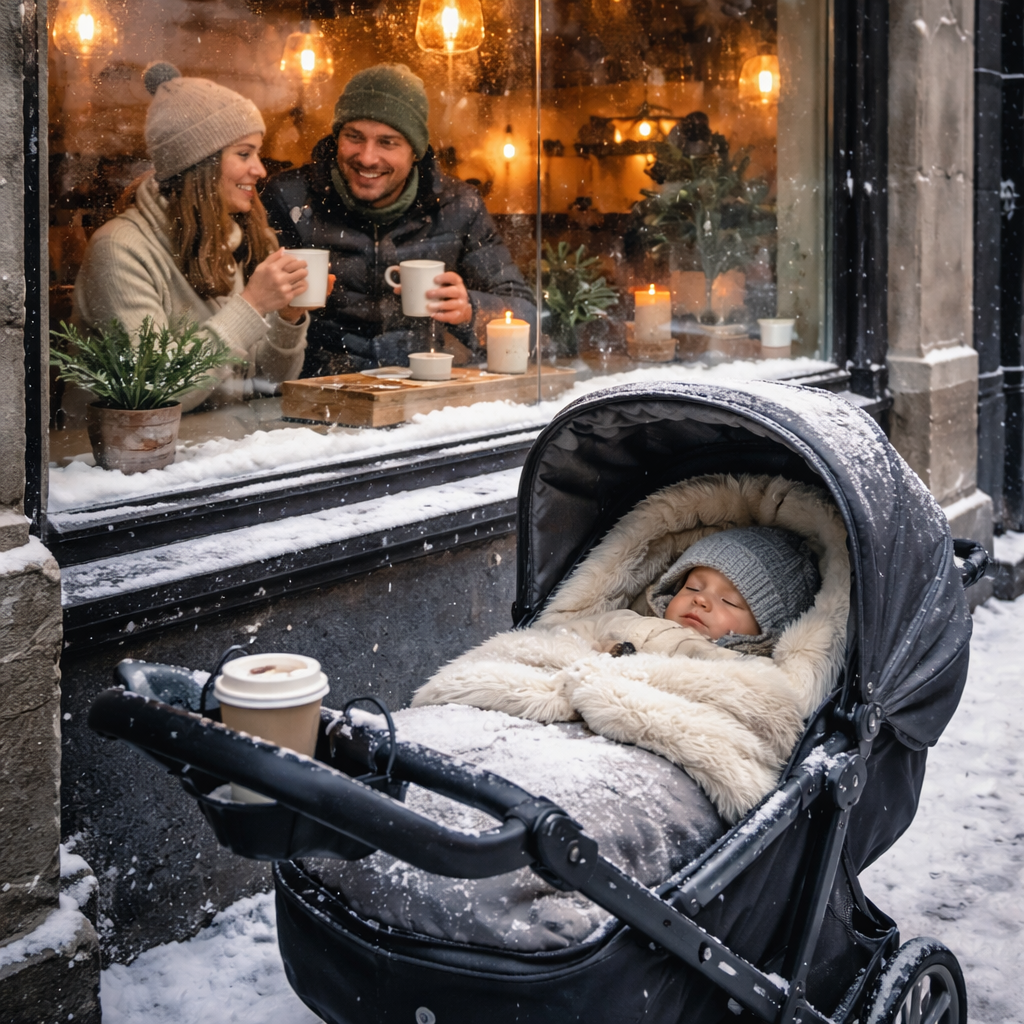
The first time I saw the photo, I almost reported it.
A stroller parked outside a café window. A baby inside. January. Stockholm.
The parents? In there. Drinking coffee.
Here's the thing: in Sweden, nobody bats an eye.
In fact, it's the opposite.
If you don't take your baby outside in the cold, you're the weird parent.
There's a word for it: "Utomhusvistelse"
It roughly translates to "outdoor stay."
The idea is simple: babies must spend time outside every day. Rain, snow, sub-zero temperatures — doesn't matter. Even daycare centers follow this rule.
There is a cutoff, technically. Below -15°C (5°F), you can stay inside.
-14°C is apparently fine.
And behind this practice is an even bigger philosophy — one Swedes call Friluftsliv. It means something like "the open air life." The belief that nature isn't something to be protected from. It's where humans are supposed to be. Starting your baby outdoors from day one is just… the beginning of that.
The research backs it up too. Finnish researcher Marjo Tourula found that babies who nap outdoors sleep on average 1.5x longer than babies who sleep indoors.
So there's that.
Meanwhile, in 1980s Korea
You know what Korean grandmothers feared most?
Wind.
Babies were bundled in a podaegi (포대기) — a traditional cloth carrier — wrapped tight, topped with a blanket, fitted with a hat. Drafty rooms were dangerous. Cold floors were dangerous. A crisp winter breeze outside? An actual catastrophe.
But here's what most people miss: this wasn't irrational.
Korean traditional medicine has a concept called "Pung" (풍) — literally "wind." For centuries, wind was understood to be the root of illness. Look at the Korean words for stroke, rheumatism, cold — they all contain the character for wind (風). The logic was precise and deeply structured: wind enters the body, disrupts balance, causes disease.
This wasn't superstition. It was a medical system. One that had been refined since the Joseon Dynasty and passed down, grandmother to mother, generation after generation.
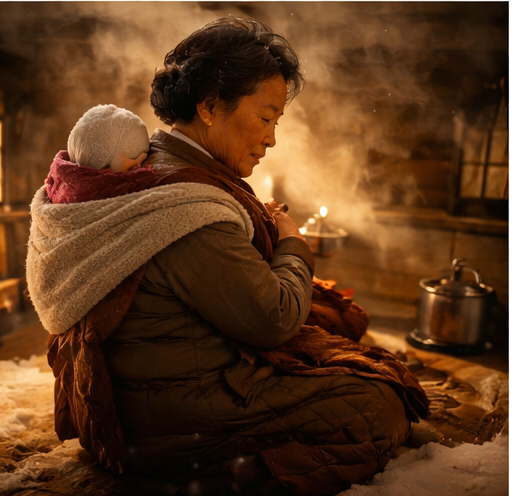
And sitting at the center of that philosophy was the pojagi.
More than a baby carrier, it was a physical statement: a baby belongs in human warmth. Strapped to their mother's back, babies felt her body heat, heard her heartbeat, saw the world from her eye level.
Leaving a baby alone in a stroller outside? That wasn't a parenting style. That was neglect.
So this was never really about temperature
The gap between Korea and Sweden wasn't warm vs. cold.
It was two completely different answers to the same question: What does a baby actually need?
Korea said: Protection. Closeness. The warmth of another human being. The outside world is something you ease into — carefully.
Sweden said: Independence. Nature. Space to exist on your own terms. The outside world is where you belong, from the very beginning.
A pojagi and a parked stroller in -10°C. Same love. Completely opposite philosophies.
Here's the twist, though
Forty years later, the two countries are quietly moving toward each other.
Korea changed. Today's Korean parents push strollers outside, bundle babies up for walks, and treat fresh air as common sense — not a threat. And the pojagi? It didn't die. It went global. It's being sold on international baby boutiques under its Korean name: "podaegi." Western parents are discovering what Korean grandmothers knew all along — keeping a baby close has its own kind of magic.
Sweden changed too. The strollers-outside-cafés tradition is still very much alive. But leaving babies completely unattended has quietly become less comfortable, especially in cities. "Within eyesight" matters more than it used to.
Two countries that were mirror opposites in 1980 are now, somehow, finding common ground.
Korea moved a little more outside. Sweden moved a little more close.
So who was right?
Honestly? I'm not sure either of them was wrong.
The grandmothers who shielded their babies from every breath of cold wind, and the parents who parked their strollers in the snow and went inside for a flat white — they both raised children. Their children grew up. Most of them turned out fine.
Maybe the most important thing in parenting was never the method.
Maybe it was always the certainty behind it.
"This is what's right for my child."
If you walked past a café in Stockholm and saw a stroller outside with a baby inside — what would you do?
How was this article?