Postpartum Care Around the World Is Wildly Different — Korea, Japan, and the Netherlands
Korea checks into a facility for a month. Japan goes back to mom's house. The Netherlands gets a nurse at home every day. Here's what each approach gets right.
If you've just had a baby in the United States, the standard experience goes something like this: two days in the hospital, then you're handed a car seat, a pamphlet about postpartum depression, and sent home to figure it out.
Most of the world, it turns out, has decided this isn't good enough. What they've built instead varies wildly — and each system reveals something different about how a culture understands new motherhood.
South Korea: The Postpartum Center
Korea has something that doesn't really exist anywhere else at scale: the sanhujoriwon (산후조리원), a dedicated postpartum recovery center where mothers spend two to four weeks after giving birth.
These aren't hospitals. They're closer to hotels crossed with newborn care facilities. Mothers eat, sleep, and attend breastfeeding consultations. Trained nurses handle the newborn — night feeds, bathing, monitoring — while the mother rests. Some centers offer massage, skin care, cooking classes, and private rooms with panoramic views of the city.
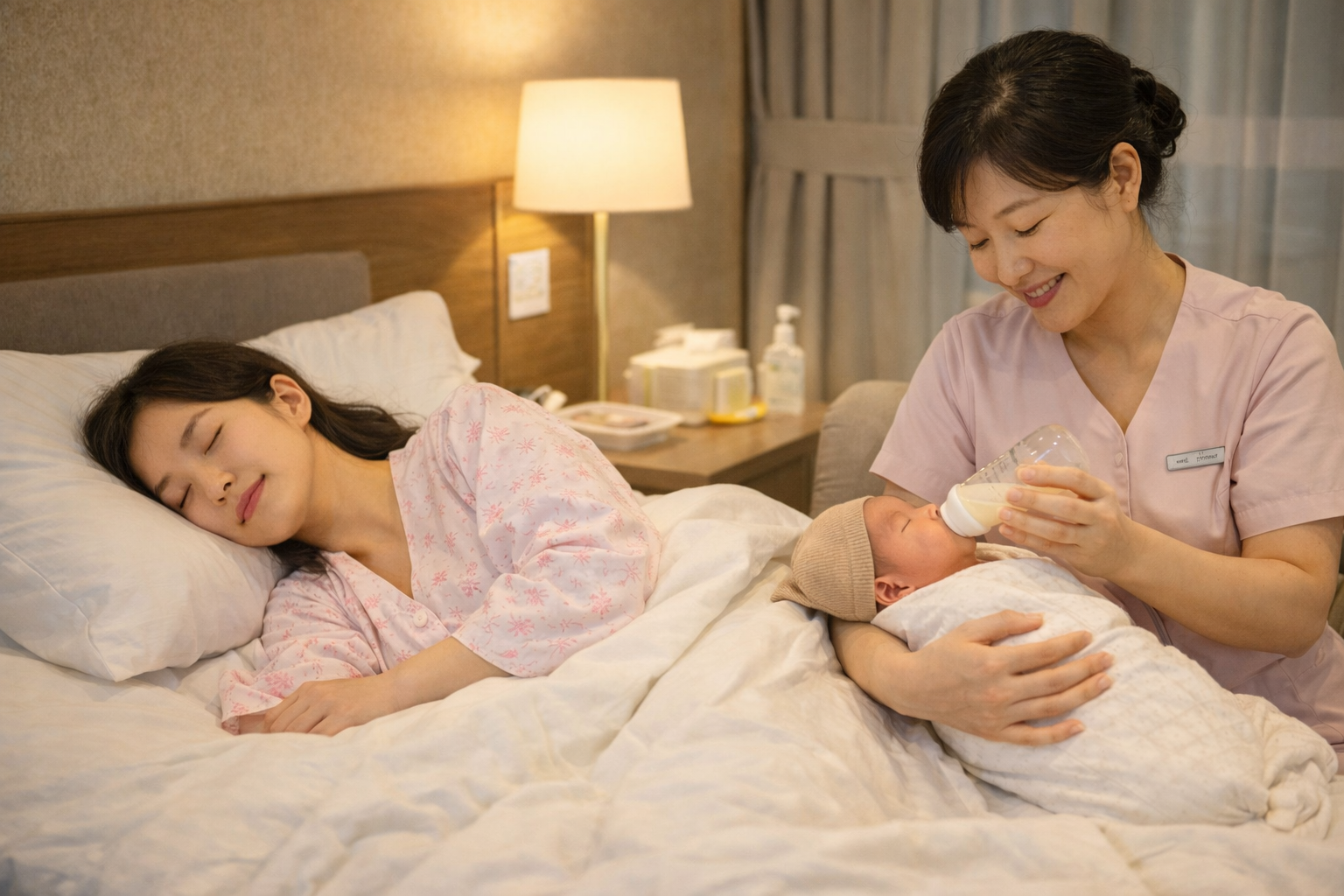
More than 75% of Korean mothers use them. The cost is significant — roughly two to four weeks can run anywhere from $1,500 to $10,000+ depending on the tier — but many Korean families treat it as a non-negotiable expense, often funded by grandparents as a gift.
The system grew out of traditional Korean postpartum beliefs: no cold water, no cold drafts, minimal activity, complete rest for roughly a month. Historically, mothers-in-law or own mothers would move in to enforce this. As Korea urbanized rapidly and extended family networks weakened, the institution stepped in to do what the family used to do.
The most honest assessment of sanhujoriwon is that they solve the sleep problem brilliantly. The leading cause of postpartum misery in most countries is catastrophic sleep deprivation in the first two weeks. Korean mothers largely sidestep this. The tradeoff — less immediate skin-to-skin time, bonding happening in a more scheduled, institutional way — is a genuine debate in Korean parenting research, but one without a clean verdict yet.
Japan: Going Home to Mom
Japan's traditional postpartum practice is called sato-kaeri (里帰り出産) — literally "going home to one's parents." A pregnant woman returns to her family home weeks before the due date, delivers locally, and stays for a month or two while her mother provides care.
For generations, this was simply what happened. The logistical infrastructure of Japanese life was built around it: obstetric clinics in smaller cities that cater specifically to sato-kaeri mothers, husbands making long-distance trains home on weekends.
The system is under significant strain. Japan's population is aging, which means maternal grandmothers are increasingly still working, or are themselves in need of care. Geographic distance between family members has grown. And the rising cost of leaving Tokyo for a month — in lost income, in apartment rent that doesn't pause — has made the tradition harder to sustain.
Japan has begun building institutional alternatives, formalizing postpartum care centers and home-visit services through municipal government programs, particularly since 2017. But coverage is uneven, and nothing has yet filled the gap at the scale that sato-kaeri once did at its peak.
The deeper cultural shift underneath this is significant: Japan is losing a postpartum safety net without having fully built a replacement, and the consequences — in postpartum depression rates, in maternal isolation — are beginning to show up in the data.
The Netherlands: A Nurse at Your Door
The Dutch approach starts from a completely different premise.
After giving birth — and the Netherlands has one of Europe's highest rates of home birth, so sometimes this is quite literal — a mother goes home and resumes her life. There's no facility to check into. There's no expectation that she'll disappear from daily life for a month.
What there is instead is kraamzorg: a trained postpartum nurse who visits the home every day for eight to ten days, typically for two to three hours per visit. She monitors the mother's physical recovery, weighs and bathes the newborn, provides breastfeeding support, assists with light household tasks, helps with older siblings, and assesses for signs of postpartum depression. The cost is covered almost entirely by national health insurance.

The philosophy embedded in this system is almost the inverse of Korea's. Where Korea says "the mother needs to be separated from normal life to recover," the Netherlands says "the mother needs to stay in her normal life, with expert support woven into it." The goal is fast, grounded adaptation — not a temporary sanctuary.
The Dutch also have a different relationship with medicalization of birth and postpartum in general. Historically, childbirth has been treated as a natural process first and a medical event second. Kraamzorg fits that framing: professional, yes, but home-based, normalized, and time-limited.
The honest limitation: after those eight to ten days, the formal support ends. What comes next is largely up to the family. For mothers without strong social networks, that cliff can be hard.
What Each System Gets Right — and Wrong
No system is clearly better. Each makes different tradeoffs.
Korea's sanhujoriwon solves sleep deprivation and provides intensive professional support — but it costs money many families can't easily access, and it separates mother and baby in the earliest days in ways that researchers are still evaluating.
Japan's sato-kaeri provides warm, continuous family support — but it depends on a family structure that is rapidly eroding, and the institutional alternatives haven't caught up.
The Netherlands' kraamzorg is cost-effective, normalizing, and home-based — but it's time-limited, and the weeks after it ends can still be very hard.
The throughline across all three is the same conclusion: the countries that have thought carefully about postpartum care all arrived at the same basic finding. New mothers need consistent, skilled support in the first weeks. What they don't do well, anywhere, is extend that support past the initial period.
The US, for what it's worth, hasn't really arrived at that finding yet.
If you went through postpartum care in any of these countries — or somewhere else entirely — what was the thing nobody warned you about?
How was this article?