Indian Mothers Have Been Doing This for Thousands of Years. Western Science Just Caught Up.
Baby massage has been a daily ritual in India since ancient times. For decades, Western medicine ignored it. Then the research came in.
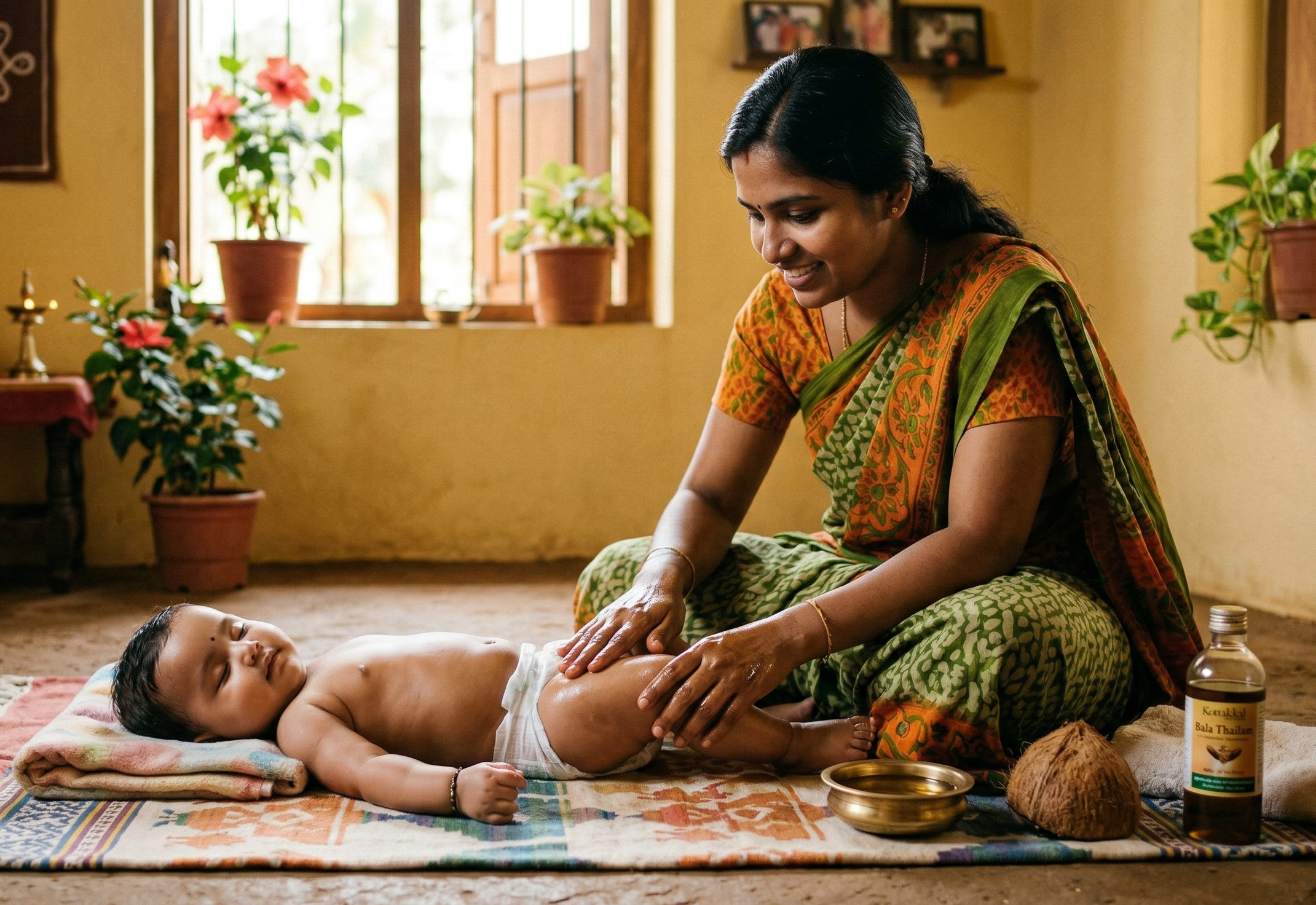
In India, you don't decide whether to massage your baby. You just do. Your mother did it to you, her mother did it to her, and the tradition stretches back through Ayurvedic medicine for thousands of years. The practice is called malish — a full-body oil massage, done daily, from the first weeks of life.
For much of the twentieth century, Western medicine looked at this and saw folk custom. Harmless, probably, but not something that warranted clinical attention.
Then researchers started looking more carefully. What they found made them reconsider a lot of assumptions about what newborn bodies actually need.
What the Research Found — and Why the Numbers Were Hard to Believe
The story starts in the 1980s at the University of Miami, where developmental psychologist Tiffany Field began studying touch and premature infants. Her team gave premature babies in the NICU three fifteen-minute massages per day.
The results were striking enough that other researchers initially questioned them. Massaged premature infants gained weight 47% faster than the control group. They were discharged from the hospital an average of six days earlier. Their developmental scores were significantly higher.
The finding has now been replicated across dozens of studies in multiple countries. The effect is real.
The mechanism makes biological sense. Touch stimulates the vagus nerve, which in turn triggers the release of insulin and insulin-like growth factor (IGF-1). The body reads sustained, rhythmic skin contact as a signal to grow. Massage isn't just comfort — it's a physiological on-switch for development.
It's Not Just Weight Gain
The premature infant research got the most attention, but subsequent studies expanded the picture considerably.
Sleep improves. Massaged infants show increased melatonin production and spend more time in deep sleep stages. For parents of newborns, this finding requires no further elaboration.
Stress hormones drop. Cortisol levels in regularly massaged infants are measurably lower. Newborns experience stress — from overstimulation, hunger, the general shock of being outside the womb — and elevated cortisol in early life has downstream effects on neurological development. Anything that reliably reduces it matters.
Neurological development accelerates. Tactile stimulation drives the development of the somatosensory cortex. The skin is the largest sensory organ, and input through it in early life shapes how the brain organizes itself.
Bonding deepens — for parents, not just babies. Parents who perform regular massage show elevated oxytocin levels. The effect isn't one-directional. Doing the massage changes the person doing it.
Why Western Medicine Took So Long to Get Here
There's something worth naming directly. Traditional practices from South Asia, Africa, and Indigenous cultures have historically been dismissed by Western medicine until they could be validated on Western medicine's own terms — peer-reviewed journals, randomized controlled trials, biological mechanisms.
Malish didn't change. The research infrastructure around it caught up. Indian mothers didn't need a study to know that daily massage kept their babies calmer, heavier, and more settled. They had generational data in a form that academic medicine wasn't designed to recognize.
This pattern repeats across traditional medicine globally. It's worth holding onto when you encounter a practice that seems backed only by "this is what we've always done." Sometimes that's exactly what it looks like. And sometimes the science is just running behind.
How to Actually Do It
You don't need to learn a formal technique. The research didn't use specialized methods — it used consistent, moderate-pressure touch.
When: After the umbilical cord stump falls off. Before a bath works well. The ideal state is an awake, alert baby who isn't hungry or overfull.
What to use: Coconut oil, sunflower oil, or a fragrance-free baby oil. Avoid anything heavily scented. Warm the oil slightly in your hands first.
How: Enough pressure that the skin moves with your hands — not feather-light, but not firm either. Strokes on the legs and arms, circular movements on the back and abdomen (clockwise on the belly, following the direction of digestion), gentle pressure on the soles of the feet.
How long: Ten to fifteen minutes. Consistency over weeks matters more than duration of any single session.
If your baby fusses or arches away, stop. Try again later. The goal isn't completing a routine — it's the sustained pattern of contact over time.
Did you grow up in a culture where baby massage was normal, or did you discover it later? The difference in how it's treated — ritual vs. technique — is pretty striking.
How was this article?